
Ownership
Types of marine survey
| Survey | Commissioned by | What it produces |
|---|---|---|
| Pre-purchase | The buyer, before settlement | Condition, defects, negotiating position, usually a valuation |
| Insurance or condition | The owner, for the insurer | Condition and value in the format an underwriter expects |
| Valuation | The owner or a financier | A reasoned market value, often for agreed-value cover |
| Damage or claim | The insurer, after a loss | Cause of loss and cost of repair |
| Tonnage and registration | The owner | Measurement for registration purposes |
| Rig survey | The owner, often at an age threshold | Condition of the mast, standing rigging and fittings |
Choosing a marine surveyor
Independence is the point. A surveyor recommended by the seller, the broker arranging your finance or the yard that will do the repairs has a relationship you are not party to. Look for recognised accreditation, experience with your hull material and vessel type, and a willingness to give you the full written report rather than a summary.
- Accreditation with a recognised Australian marine surveying body.
- Demonstrable experience in your hull material — timber, steel, ferrocement and carbon each need a specialist.
- No commercial relationship with the seller, the yard or the broker.
- Professional indemnity insurance, which you can ask to see.
- A sample report, so you know what you are buying.
Insurance survey scope and inspections
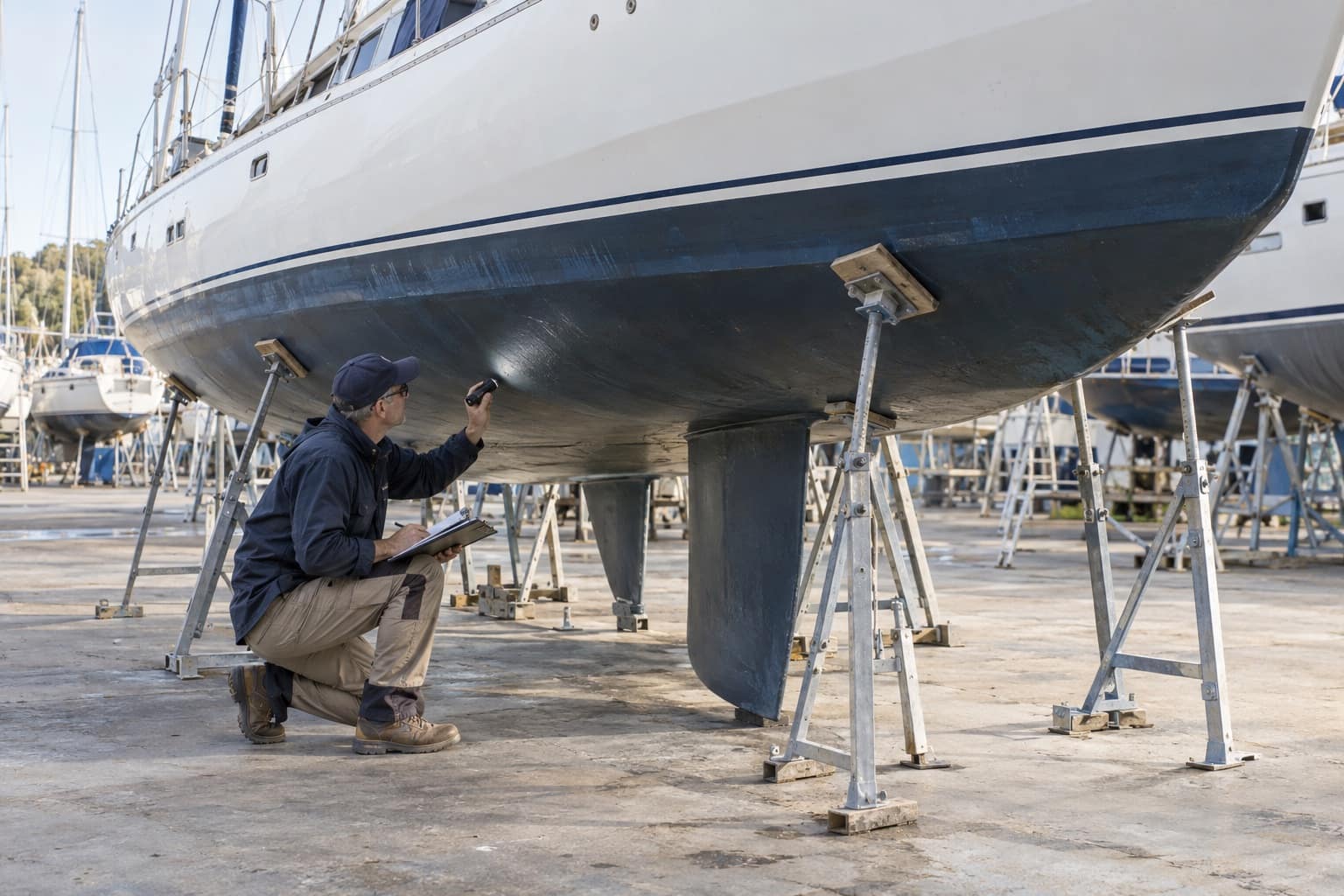
- The vessel is hauled out so the underwater body, keel joint, rudder, shaft and through-hulls can be inspected.
- The hull is sounded and moisture-metered, and any suspect areas investigated further.
- The deck, coachroof, hardware and chainplate seals are examined.
- The rig is inspected, either from the deck or aloft depending on the scope agreed.
- Machinery, steering, electrical and gas systems are checked, usually visually rather than by dismantling.
- Sea trial where scoped, covering engine performance, steering and handling under load.
- The written report follows, with findings graded by urgency and a valuation where requested.
Survey recommendations and policy conditions
This is the part owners underestimate. Surveyors typically grade findings — safety critical, needs attention this season, advisory. Insurers usually require the first two categories to be rectified within a stated period, and where those requirements are endorsed onto your schedule they are conditions of the policy, not suggestions. A recommendation left outstanding past its date can be the reason a later claim fails, including one that looks unrelated.
- Ask the insurer in writing which recommendations they require and by when.
- Rectify those items and keep the invoices and photographs.
- Send the evidence back to the insurer and ask them to confirm the condition is discharged.
- File the report, the rectification evidence and the confirmation together.
- Diarise the date the current survey expires.
Marine survey costs
Survey cost scales with vessel size, the scope agreed and whether a haul-out and sea trial are included, and the haul-out is often a separate yard charge. Against a purchase price or a sum insured it is small, and it is the only document that gives you an independent, dated baseline of the boat's condition — which is worth as much at claim time as it is at purchase.
Condition is what decides marine claims
Almost every declined marine claim is an argument that a failure was gradual rather than sudden. The records you keep are what answers it.
Marine surveys at a glance
- Sets
- The sum insured, and the evidence behind it
- Establishes
- Condition at a known date — your claim-time baseline
- Produces
- Recommendations that usually become policy conditions
- Required
- Commonly above a vessel age threshold; varies by insurer
- Independence
- From the seller, the yard and the broker
Related guides
- Pre-Purchase Survey vs Insurance Survey
- Can You Get Boat Insurance Without a Survey?
- Insuring a Boat Over 30 Years Old in Australia
- Boat Maintenance Records and Insurance Claims
- Boat Insurance Sum Insured: Choosing Your Vessel Value
- How To/Survey And Older Boats
- Yacht Insurance Surveys: Completing Required Repairs
- Boat Insurance Underwriting: Surveys, Age and Maintenance
- Boat Sum Insured Calculator
- Catamaran Survey Defects Before Insurance Starts
- Beneteau Model Insurance Guides